
Why Selling Near Cost Makes a Better Fundraiser
Every traditional fundraiser asks a supporter to overpay on purpose. A supplement fundraiser priced a few dollars above cost does the opposite, and that single change is what makes the supporter buy again next month without anybody asking.

What a normal fundraiser actually asks of people
Think about the last product fundraiser you bought from. A candy bar, a tub of cookie dough, a roll of wrapping paper, a candle. You paid more than the item is worth, knowingly, because a kid you like was standing in front of you. The overpayment was the donation, dressed up as a purchase.
That structure works exactly once per person per season. The buyer has no reason to seek out the product again, because the product was never the point. When the fundraiser ends, the revenue ends, and next year you start over from zero with a slightly more reluctant audience.
Supplements are usually sold the same way, just at higher prices. The retail supplement business carries a lot of cost between the factory and the shelf: brand marketing, retailer margin, distributor margin, shelf space, packaging designed to be noticed from four feet away. All of it gets priced in, several times over, and the customer pays the sum.
The pricing model, plainly
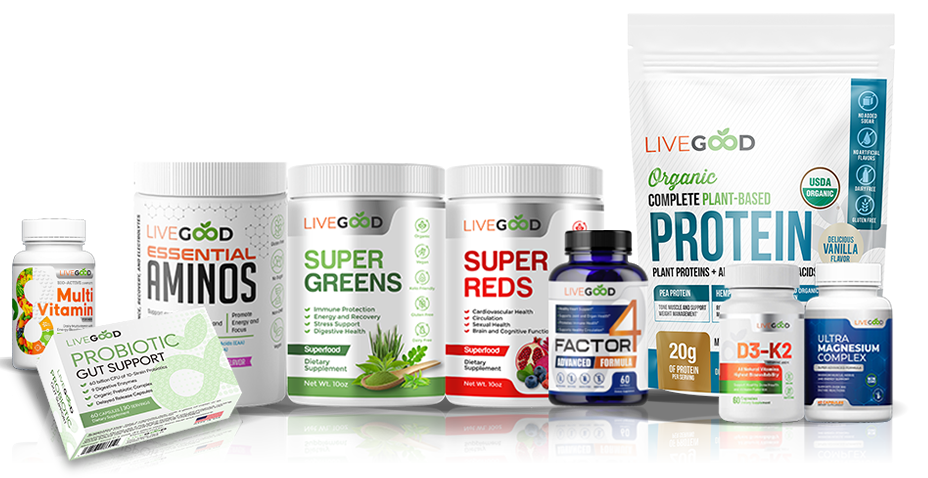
LiveGood sets prices a few dollars above cost. There is no retail markup stack to fund, because the products do not travel through a retail chain. The buyer joins as a member and pays the member price, and the order ships direct to their door.
These are real price pairs from the catalog:
| Product | Comparable retail | Member price |
|---|---|---|
| Organic D3-K2 2000 | $9.50 | |
| Ultra Magnesium Complex | $9.95 | |
| Herbal Radiance Enriched Toner | $11.95 | |
| Bio-Active Complete Multi-Vitamin for Men | $12.95 | |
| Organic Children's Multi-Vitamin Gummies | $15.95 | |
| Probiotic Gut Support | $17.95 | |
| Super Greens | $19.95 | |
| Super Reds | $19.95 | |
| Organic Coffee | $19.95 | |
| Collagen Peptides | $29.95 | |
| Essential Oils | $29.95 | |
| Whey Protein Isolate | $39.95 |
Across the full catalog of 46 products, member prices run from $9.50 to $39.95. Notice that the gap is not uniform. On the D3-K2 and the toner it is dramatic. On the whey isolate it is modest. That is what near-cost pricing looks like in practice: the discount is whatever the retail markup happened to be, not a marketing number chosen to look impressive.
In a normal fundraiser the supporter loses money to help you. Here they save money and you still get paid.
Why that inverts the whole dynamic
Your organization earns 20% of every first order placed through a participant's link, and 10% of every reorder that customer places afterward, for as long as they keep ordering. Those two percentages are the same in any version of this. What changes is whether the second one ever happens.
A supporter who overpaid does not reorder. There is nothing in it for them. A supporter who paid less than they were paying at the store has a reason to come back that has nothing to do with your fundraiser, your team or their affection for your kid. They come back because the price is good and the box arrives.
So the recurring percentage stops being theoretical. The 10% is only worth something if reordering is the natural behavior rather than a favor, and reordering is only natural if the buyer came out ahead.
There is a second effect worth noting. Because the buyer is saving money, the participant's ask changes character. A student is not asking for charity. They are telling somebody about a cheaper way to buy something they already buy. That is a much easier sentence for a shy fourteen-year-old to say out loud.
Where this model does not work
Being honest about the limits is the only way the rest of this is worth reading.
It only works if people want the products
Near-cost pricing on something nobody uses is a discount on nothing. If your families do not take vitamins, drink coffee, use protein, buy skincare or own pets, the price advantage is irrelevant and you should run a different fundraiser. Ask five parents honestly before you present this to a board.
The first order is smaller than a donation drive
A direct ask can produce a fifty dollar check from someone who never buys anything again. A first order at 20% of a member price is a smaller number on day one. The model is betting on month six, not on launch week.
Nothing here is guaranteed
Earnings depend entirely on how many customers your group brings in and whether those customers keep ordering. Some communities take to it and some do not. Anyone who tells you otherwise is selling something.
The test I use with committees
Show a parent the price pairs above with no mention of fundraising at all. If their reaction is "wait, how much?", the model fits your community. If their reaction is a polite nod, it does not, and no amount of enthusiasm from the committee will change that.
What this means for planning
Budget the first orders as this season's money and the reorders as next season's baseline. They are genuinely two different revenue streams that happen to come from the same customer, and treating them as one number is how committees end up disappointed in week three and pleasantly surprised in month eight.
If you want to see the arithmetic move with your own roster size, the fundraising calculator lets you set the assumptions yourself. If you want to know what is actually in the catalog before you judge any of this, that is covered in what is actually in the catalog.
See the prices before you decide anything
Look at the catalog, check the member prices against whatever your family buys now, and then tell me whether it would fly in your community. I will give you a straight answer either way.
Start your fundraiser Free to start. Earnings depend on the customers your organization brings in; no specific income is guaranteed.
Misty Gaunt
Misty helps schools, teams, churches and nonprofits set up recurring fundraisers through LiveGood. She will look at your roster and tell you whether the model fits before you commit to anything. Call or text 615-414-3837.